


The article by Sullivan Rohan titled “Genemap proves platypus is part bird, mammal and reptile”, published on ABC news in 2008 (Sullivan, 2008), largely misinterpreted the phylogenetic tree and the platypus’ placement on it, which was shown through the sequencing of the platypuses genome in 2008 (Warren et al., 2008). My favourite animal is, amongst elephants, a platypus and I would like to set the record straight by debuncing this false science myth. What are platypuses, really?
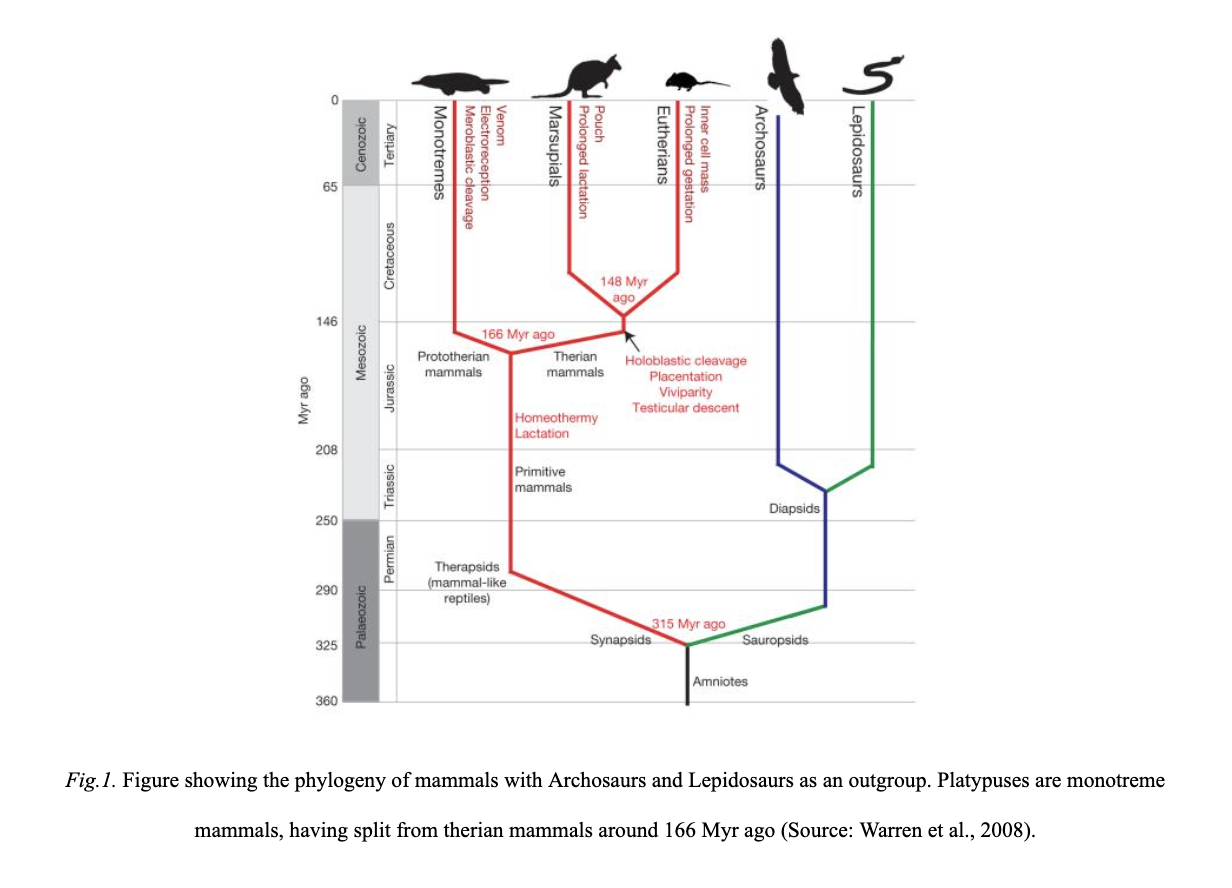
Firstly, it is incorrect to say that a platypus is “part bird, mammal and reptile”. Platypuses are part of the monotreme mammals, which split from other mammals around 160 million years ago (see figure 1). Only three modern species of monotreme mammals remain today. Placentals, monotremes and marsupials all share a most recent common ancestor (MRCA) that is not shared with birds (see figure 1, 166 Myr ago). In that logic, Homo Sapiens would be just as “part bird” or “part reptile” as the platypus is: indeed, our furless appearance would make us more closely related to reptiles. This logic is misinterpreting platypuses to be more “basal” than placentals or marsupials, simply because they diverged earlier and show ancestral traits. However, platypuses have evolved over the same amount of time as kangaroos or humans have. Platypuses have preserved ancestral traits of the MRCA of mammals, such as egg-laying, while placentals and marsupials have lost those traits. Lactation in platypuses is an example of a synapomorphy of mammals. Likewise, fur is a synapomorphy across mammals - a trait we have lost. Surprise! We are not “part-reptile”.
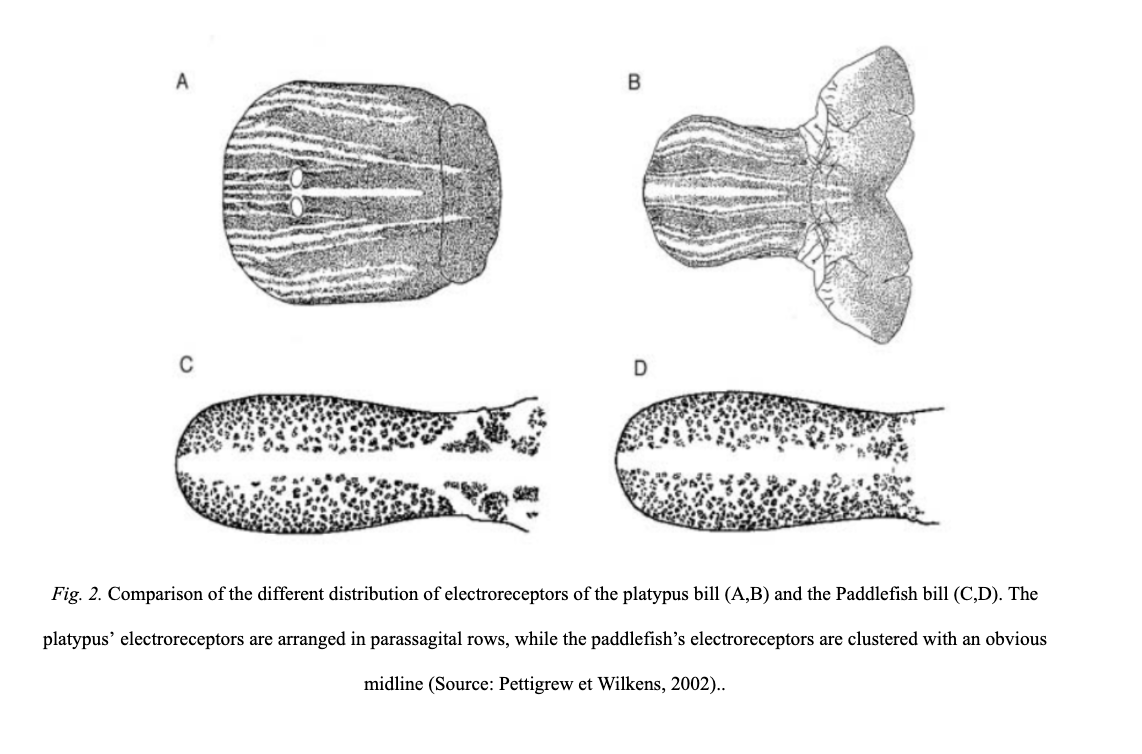
Secondly, it is wrong to say that a platypus has a “bill like a duck’s” or “snake-like venom”, making it ”part bird, [...] and reptile.” A platypus’ bill evolved independently. Ancestral mammals did not have “duck bills”. The platypus bill is a highly derived tool for food foraging and prey detection with over 40’000 electroreceptors (Pettigrew et Wilkens, 2002) . To clarify why the platypus and duck bill is a result of convergent evolution, one can bring in another species: the paddlefish. As in ducks and platypuses, its bill has thousands of electroreceptors, fulfilling similar functions of prey detection (Pettigrew et Wilkens, 2002). Along the lines of logic in the ABC News article, the platypus might as well be “part fish” and have a bill “like a paddlefish” (of course, no-one would say that). A comparison of the paddlefish and platypus’ bill, shows that although the bill fulfills the same purpose of food foraging in a murky environment, the arrangement of electroreceptors is different, as a result of convergent evolution and due to their different placements on the phylogenetic tree. Both ducks and platypuses developed their bills long after evolving from their common ancestor around 315 Myr ago (see figure 1).
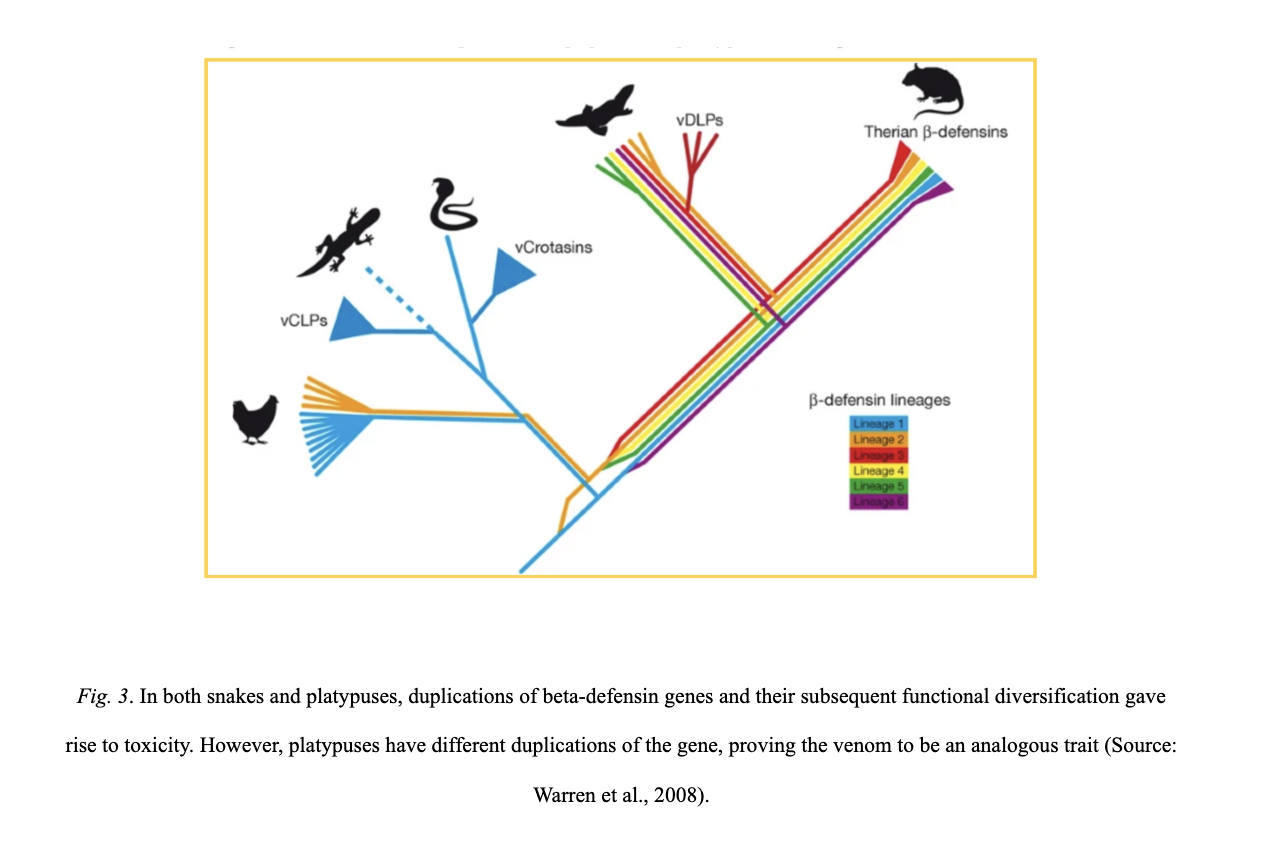
Finally, a platypus has as much “snake-like venom” as a snake has “platypus-like venom”. The highly potent venomous spine found on the hind legs of a platypus is another example of convergent evolution (Warren et al., 2008; Zancolli et al., 2021). It is not a “retained characteristic[s] of snakes and lizards” (Sullivan, 2008). The venom genes found in reptiles are not the same as the platypus’. Just as wings in butterflies, birds and bats have evolved independently for the same purpose, the platypus’ and snake’s venom has done so as well (Petto et Mead, 2009; Warren et al., 2008).
Concluding, the gene map of a platypus does not prove a platypus being “part bird, mammal and reptile”, making it an primitive “amalgam” (that, in fact, does not exist). As any present-day species, the platypus is a mixture of ancestral and derived traits. Platypuses are monotreme and a strikingly beautiful testament of evolution.
Pettigrew, J. D., & Wilkens, L. (2002). Paddlefish and Platypus: Parallel Evolution of Passive Electroreception in a Rostral Bill Organ. Sensory Processing in Aquatic Environments, 420–433. https://doi.org/10.1007/978-0-387-22628-6_22
Petto, A. J., & Mead, L. S. (2009). Homology: Why We Know a Whale Is Not a Fish. Evolution: Education and Outreach, 2(4), 617–621. https://doi.org/10.1007/s12052-009-0183-7
Sullivan Rohan, Associated Press. (2008, May 11). Gene map proves platypus is part bird, mammal and reptile. ABC News. Retrieved September 15, 2022, from https://abcnews.go.com/Technology/story?id=4828261&page=1
Warren et al. (2008). Genome analysis of the platypus reveals unique signatures of evolution. Nature, 453(7192), 175–183. https://doi.org/10.1038/nature06936
Zancolli, G., Reijnders, M., Waterhouse, R. M., & Robinson-Rechavi, M. (2021, December 30). Convergent evolution of venom gland transcriptomes across Metazoa. Proceedings of the National Academy of Sciences, 119(1). https://doi.org/10.1073/pnas.2111392119


